
Contemplative Practice
Be still and rest your anxious mind
Before the sermon, before any service, before the words — there is silence. Contemplative practice is the discipline of returning to that silence: not as an escape from life, but as the ground beneath it. Here you will find practices, reflections, and teachers for the inner journey.
Lectio Divina
Sacred reading — a Christian practice of moving through a short scripture passage slowly, listening for what stirs rather than what instructs.
- I
Lectio — Read
Read a short passage slowly, aloud if possible. Let the words land. Notice which word or phrase catches you — not the one you think should, but the one that does.
- II
Meditatio — Reflect
Read again. Sit with the word or phrase that caught you. Turn it over gently, the way you might hold a stone. What does it ask of you today?
- III
Oratio — Respond
Speak or write your response — honestly, even if what arises is resistance, grief, or gratitude. This is prayer as conversation, not performance.
- IV
Contemplatio — Rest
Set the words aside. Sit in open-handed quiet for a few minutes — not trying to think or not think, simply remaining present with the One who is always already here.
Centering Prayer
Developed from the Desert Fathers and formalized by Thomas Keating and Basil Pennington, centering prayer is a consent — a wordless turning toward the presence of God rather than an attempt to reach it (Keating, 1986).
Choose a sacred word (one syllable works well — love, peace, open, yes) as a symbol of your consent to God's presence and action within you.
Sit comfortably. Close your eyes. Introduce the sacred word gently.
When thoughts, feelings, or sensations arise — and they will — return ever so gently to the sacred word. Not as a battle but as a soft returning.
Sit for 20 minutes. At the end, remain in silence for two or three minutes before returning to ordinary awareness.
Psalm adaptations, blessings & pastoral prayers
These adapted psalms, blessings, and pastoral prayers are written for spoken or sung use in worship and in private prayer.
Blessing - Pentecost - Year B
A Pentecost blessing and prayer drawn from John 15–16, Psalm 104, and Acts 2, written for worship on the Day of Pentecost, Year B. The piece invokes the Spirit's fire and breath as a call to hear diverse voices and meet them with grace.
Psalm 143 adapted
An adapted version of Psalm 143 recast in communal voice, blending the psalmist's cry for deliverance with a posture of corporate lament and trust. The adaptation shifts singular pronouns to plural, shaping the ancient prayer for congregational use in Lent.
Psalm 27 (adapted)
Psalm 27 adapted for communal worship, recast from singular first-person to collective 'we' to invite shared trust amid suffering and uncertainty. The adaptation breaks the psalm into titled sections for meditative use, offering calm and confidence in the face of illness, chaos, and personal trial.
Psalm 54 adapted
Psalm 54 adapted as a prayer of vindication in response to the invasion of Ukraine, calling on God to save, vindicate, and deliver a people under assault. The psalmist's ancient cry for divine help is reframed as intercession for a nation facing ruthless aggression.
Pastoral Prayer - 25 Jun 2017
A pastoral prayer offered in corporate worship, inviting the congregation into quiet meditation and humble gratitude before God. It calls the gathered community to trust divine wisdom, seek mercy, and remember neighbors in need of compassion.
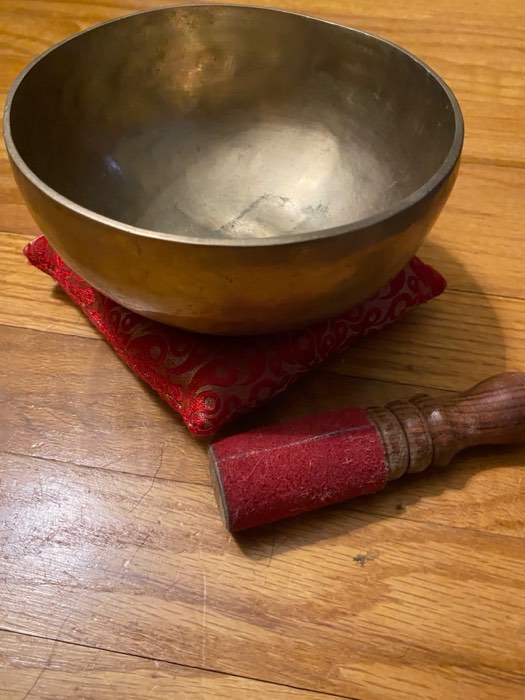
Mindfulness Meditation
Mindfulness is the practice of paying full attention to the present moment — to breath, sensation, thought, and feeling — without judgment and without trying to change what is there. Rooted in Buddhist tradition and embraced across contemplative paths, mindfulness asks nothing more than that you notice what is already here.
It is not about emptying the mind or achieving a special state. The mind will wander — that is its nature. The practice is in the returning: gently, without frustration, again and again. Each return is the practice itself.
Posture
Posture is the foundation of the sitting. The body and the mind support each other: when the body is grounded and upright, the mind settles more naturally.
Sit cross-legged on a folded blanket or meditation cushion, or in a chair with both feet flat on the floor. A cushion under the hips helps keep the pelvis level and the lower back at ease.
Sit fully upright — not rigid, but tall and relaxed. Let the vertebrae gently stack upon one another, each one resting on the one below, rising naturally without forcing. The shoulders settle back and down. The chin drops very slightly so the back of the neck lengthens.
Rest the hands on the knees or loosely in the lap. This posture can be held without strain for a full twenty-minute sitting.
A Sitting
Close your eyes gently, or soften your gaze toward the floor a few feet ahead.
Bring your full attention to the breath — not to control it, but simply to feel it: the rise and fall of the chest, the cool air at the nostrils, the pause between inhale and exhale.
When a thought, sound, or sensation draws your attention away, notice it without judgment, and return to the breath.
Sit for as long as feels right — even five minutes is a beginning. Then allow that to grow over time and practice.
For community mindfulness practice — using a bell or chime to open and close a shared sitting — see the Community Sitting Practice guide in Publications.
For community-based mindfulness support, see Refuge Recovery, which offers virtual and in-person sessions.
Zen & Taoist wisdom
These lessons and meditations are drawn from Zen, Taoist, and martial arts traditions. Open your heart to the lessons and allow your mind to expand these, not only at face value, but for the internal concepts — the relationships, the ideas, & the suggestions.
Tao Te Ching
The wise person embraces the One and sets an example for all.
Not putting on a show, he shines;
not justifying himself, he is distinguished;
not boasting, he is acknowledged.
He does not quarrel, so no one quarrels with him.If one does not begin with the right attitude,
there is little hope for the right ending.
— Lao Tzu (Walker, Trans., 1995)
To Flow with the River
Empty your mind. Be formless, shapeless, like water.
When you put water into a cup, it becomes the cup;
when you put water into a bottle, it becomes the bottle;
when you put water into a teapot, it becomes the teapot.
Now water can flow — or it can sink.
Be water, my friend.
— Lee (1971)
Zen
The Cup
It was obvious to the master from the start of the conversation that the professor was not so much interested in learning about Zen as he was in impressing the master with his own opinions and knowledge. As the Zen teacher explained, the learned man would frequently interrupt him with remarks like “Oh, yes, we have that too.”
Finally the Zen teacher stopped talking and began to serve tea. He poured the cup full, then kept pouring until the cup overflowed. “Enough!” the learned man interrupted. “The cup is overfull — no more will go in!”
“Indeed,” answered the Zen teacher. “Like this cup, you are full of your own opinions and speculations. If you do not first empty your cup, how can you taste my cup of tea?”
(Hyams, 1979)
Zen
The Dying Teacher
When Yaoshan was dying, he suddenly shouted, “Now the meditation hall is going to collapse!”
The monks began looking around for wooden poles to support the structure.
Yaoshan raised his hand and said, “No, no, you don't understand,” and then he died.
The Outlaw
One day, an ostentatious and contemptuous outlaw was thrashing about a small village. He came upon the house of a master, having heard stories of the master's legendary skill, and wanted to test it.
He came to the gate. The master was tending his garden. The outlaw called out to him, boasting that he could beat him with a single strike. He taunted the master and cried of his ignorance and bogus skill. “Challenge me if you can, and show me your best technique.”
At this, the master turned to the outlaw, bowed to him, and walked back into the house.
The outlaw became furious and ranted that the legends of the master were untrue and undeserving. A short moment later, the master reappeared — this time carrying a tray with a pot of tea and two cups. He sat near a table and poured. Then he gestured the outlaw to drink with him.
The outlaw, caught off guard, bowed to the master and left him alone.
— Tony E Hansen
Words of Fools
A word whispered in the ear
can be heard for miles.Mischief results from
too much opening of the mouth.When the blind lead the blind,
they both fall into the water.
— Drawn from Zen wisdom; Proverbs 18; and Matthew 15:14
Meditation
Enigma of Reality
enigma? essence. equilibrium.
encircle —within or without?
to be or not to be?
to see or not to see?
to feel or not feel?to be but not to be?
to see but not to see?
to feel but not to feel?a symbol, a distraction of reality —
what is reality?
what is the focus?to breathe and to see with the mind's eye;
to hear and to feel with the essence of life.the focus is the essence of pure thought;
the focus is the essence of nature;
the focus is the essence of flowing rivers.the focus is not the rock, but it is the rock —
then the focus is not the reality, but it is reality.
— Tony E Hansen
Wisdom across traditions
Sufi
“Out beyond ideas of wrongdoing and rightdoing, there is a field. I'll meet you there.”
— Rūmī (Barks, Trans., 1995)
Zen / Mindfulness
Breathing in, I calm my body.
Breathing out, I smile.
Dwelling in the present moment
I know this is a wonderful moment.
— Thích Nhất Hạnh, Being Peace (1987)
Further resources
- Center for Action and Contemplation
Richard Rohr's center integrating Christian mysticism, non-dual thinking, and social action. Daily meditations available free by email.
- Contemplative Outreach
Thomas Keating's organization for centering prayer. Includes instructional videos, local groups, and retreat resources.
Receive future meditations
New contemplative reflections and guided practices will be published here as the ministry grows. Subscribe to receive them in your inbox alongside the weekly sermons and reflections.
Get in touchReferences
- Barks, C. (Trans.). (1995). The essential Rumi. HarperSanFrancisco. (Original work by Jalāl ad-Dīn Rūmī, 13th century)
- Gethin, R. (1998). The foundations of Buddhism. Oxford University Press.
- Hyams, J. (1979). Zen in the martial arts. J. P. Tarcher.
- Keating, T. (1986). Open mind, open heart: The contemplative dimension of the gospel. Amity House.
- Lee, B. (Interviewee). (1971, December 9). The Pierre Berton show [Television interview]. CTV.
- Nhất Hạnh, T. (1987). Being peace. Parallax Press.
- Walker, B. B. (Trans.). (1995). The Tao te ching of Lao tzu. St. Martin’s Griffin.
Looking for sermon and worship materials? Visit Publications. For those exploring ministry, see the Ordination page.
Original content on this page is © Tony E Hansen / Hope and Truth Ministry. Free to share with attribution. Terms of use →